Learning that one or both fallopian tubes appear blocked can be distressing, particularly when you have been trying to conceive for some time. It is important to know that not every blockage is the same. Some blockages are located at the very beginning of the tube, where they can sometimes be treated without major surgery. Hysteroscopic tubal cannulation is a procedure designed for this situation.
This page explains what tubal cannulation is, which women may benefit, what happens during the procedure, its limitations and risks, and when other options such as laparoscopy or IVF may be more appropriate. It is general educational information. Whether this procedure is suitable can only be decided after a personal clinical assessment.

The fallopian tubes carry the egg from the ovary to the uterus. Fertilisation normally takes place inside the tube, and the early embryo then travels into the uterus. If the tubes are blocked or damaged, the egg and sperm may be unable to meet, which is a recognised cause of female infertility.
A tubal block can occur at different points: near the uterus (proximal), in the middle, or near the ovarian end (distal). The location, and the cause, greatly influence what treatment is likely to help.
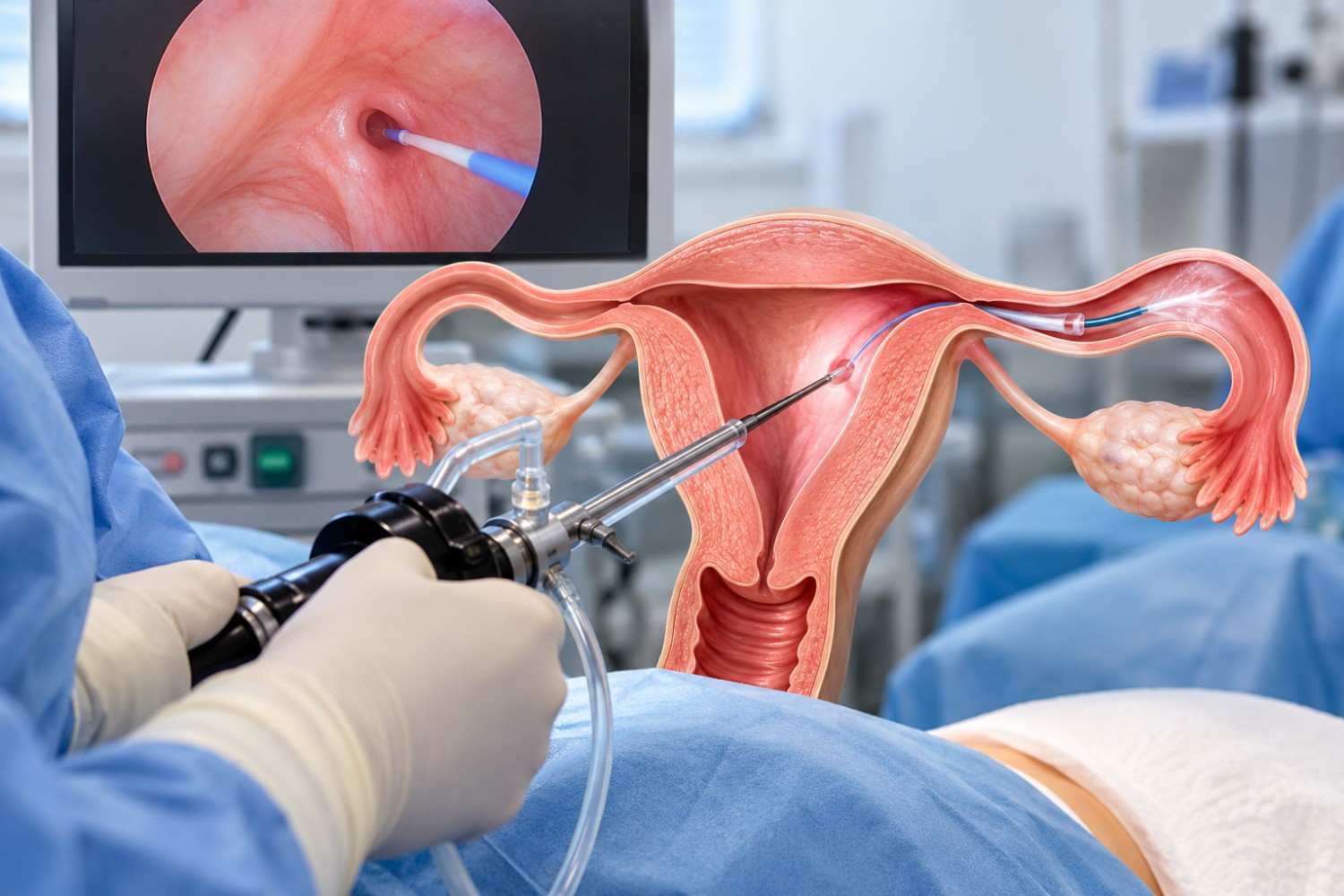
Tubal cannulation is a minimally invasive procedure used to open a blockage at the proximal end of the fallopian tube, where the tube meets the uterine cavity. A hysteroscope, a thin telescope, is passed through the cervix to view the uterine cavity and the tubal openings. A very fine catheter, sometimes with a soft guidewire, is then gently guided into the tubal opening to clear a plug or to confirm whether the tube can be opened. Dye may be passed afterwards to check whether the tube is open.
The procedure is performed through the natural passage, without cuts on the abdomen. In some women it is combined with laparoscopy, or with imaging guidance, so that the tube can be assessed from the outside as well.
Not every blockage seen on an HSG X-ray test is a permanent block. Several mechanisms are possible:
Tubal cannulation may be considered when:
Tests suggest a proximal (cornual) tubal block, and the other parts of the fertility evaluation are suitable.
The remainder of the tube appears healthy, and the partner's semen analysis is acceptable.
The woman prefers to try a tube-opening procedure before moving to IVF, after counselling about the chances.
It is generally not suitable, or less likely to help, when there is severe tubal damage, a distal blockage, hydrosalpinx (a fluid-filled, damaged tube), extensive pelvic adhesions, suspected active genital tuberculosis, or when other significant fertility factors, such as advanced age, reduced ovarian reserve or severe male factor infertility, are present. In these situations IVF may be a more direct option.
Understanding how tubal evaluation is performed, what happens during hysteroscopic tubal cannulation, and what aftercare involves.
Before the procedure, your doctor will review your history and previous reports, including your HSG or other tubal tests. Additional tests may include ultrasound, hormonal tests for ovarian reserve and a semen analysis for your partner. Where the tubal findings are unclear, hysteroscopy, with or without laparoscopy, may be used to confirm the diagnosis before any treatment is attempted.
Tubal cannulation is usually done in an operation theatre under short anaesthesia or sedation. It is typically scheduled after your period has finished and before ovulation, and a pregnancy test is done beforehand. After the hysteroscope shows the cavity and the tubal openings, a fine catheter is introduced into the proximal tube. Dye may then be passed to check for patency. The procedure is generally short, and most women go home the same day once they have recovered from the anaesthesia.
Mild cramping and light spotting for a few days are common. Your doctor may prescribe pain relief and, in some cases, medicines to reduce infection risk. Most women return to routine activities within a day or two. You will be advised when to resume intercourse and when to try to conceive, and you may be monitored for ovulation or advised on timed intercourse or IUI where suitable. Please contact your doctor promptly if you have fever, severe pain, heavy bleeding or foul-smelling discharge.
Understanding the potential benefits, limitations, safety considerations, and when another fertility treatment option may be better.
The potential benefit of cannulation is that, in a carefully selected woman, it may restore tubal patency and allow a chance of natural conception without IVF. It is not guaranteed to work. A tube that opens may not function normally, and a tube may block again later. Outcomes depend on the cause of the blockage, the health of the rest of the tube, age and other fertility factors.
Risks include infection, bleeding, injury or perforation of the uterus or tube, a reaction to anaesthesia and, if imaging with radiation is used, radiation exposure. After any tubal procedure, there is a slightly higher chance that a later pregnancy may implant in the tube (ectopic pregnancy), so you should seek early medical evaluation if you have a positive pregnancy test or pain and bleeding.
If the tubes cannot be opened, if there is hydrosalpinx or extensive tubal damage, or if other fertility factors are significant, other treatment may be more suitable. Laparoscopic assessment or tubal surgery may be considered in some cases. For many women with serious tubal disease, IVF, which bypasses the tubes altogether, offers a more reliable route.
Your doctor will discuss the choices honestly so that you can decide without undue delay, particularly if you are over 35.
Dr. Sunita Arora is an obstetrician, gynaecologist and fertility specialist with more than 23 years of experience. She holds an MBBS from Lady Hardinge Medical College, New Delhi, and an MD in Obstetrics and Gynaecology from UCMS and GTB Hospital, and she is a Fellow of the Indian College of Obstetricians and Gynaecologists (FICOG) and a Fellow of the International College of Surgeons (FICS). She completed a fellowship in Reproductive Medicine at D.Y. Patil University, Mumbai, and received IVF training at RMA, Mount Sinai, New York.
Her special interests include endoscopic surgery, infertility, IUI and IVF, which allows tubal problems to be assessed and managed within a complete fertility plan.
If you have been told that your fallopian tubes are blocked, a careful review of your reports can help you understand whether tubal cannulation, laparoscopy or IVF is the right path.
She consults at Safdarjung Enclave and is also associated with Fortis La Femme, Greater Kailash II, serving women across South Delhi, including Greater Kailash, Green Park, Hauz Khas and nearby areas.
Dr Sunita Arora Fertility and Gynae Clinic
Fortis La Femme, South Delhi
Book an appointment with Dr. Sunita Arora to discuss your options and plan the next steps.
Find answers to common questions about hysteroscopic tubal cannulation, diagnosis, pregnancy timing, and safety.
Medical disclaimer: This page is for general educational purposes and does not replace personalised medical advice, diagnosis or treatment. Please consult a qualified doctor about your own health. If you have severe abdominal pain, heavy bleeding, fainting or fever, seek urgent medical care.