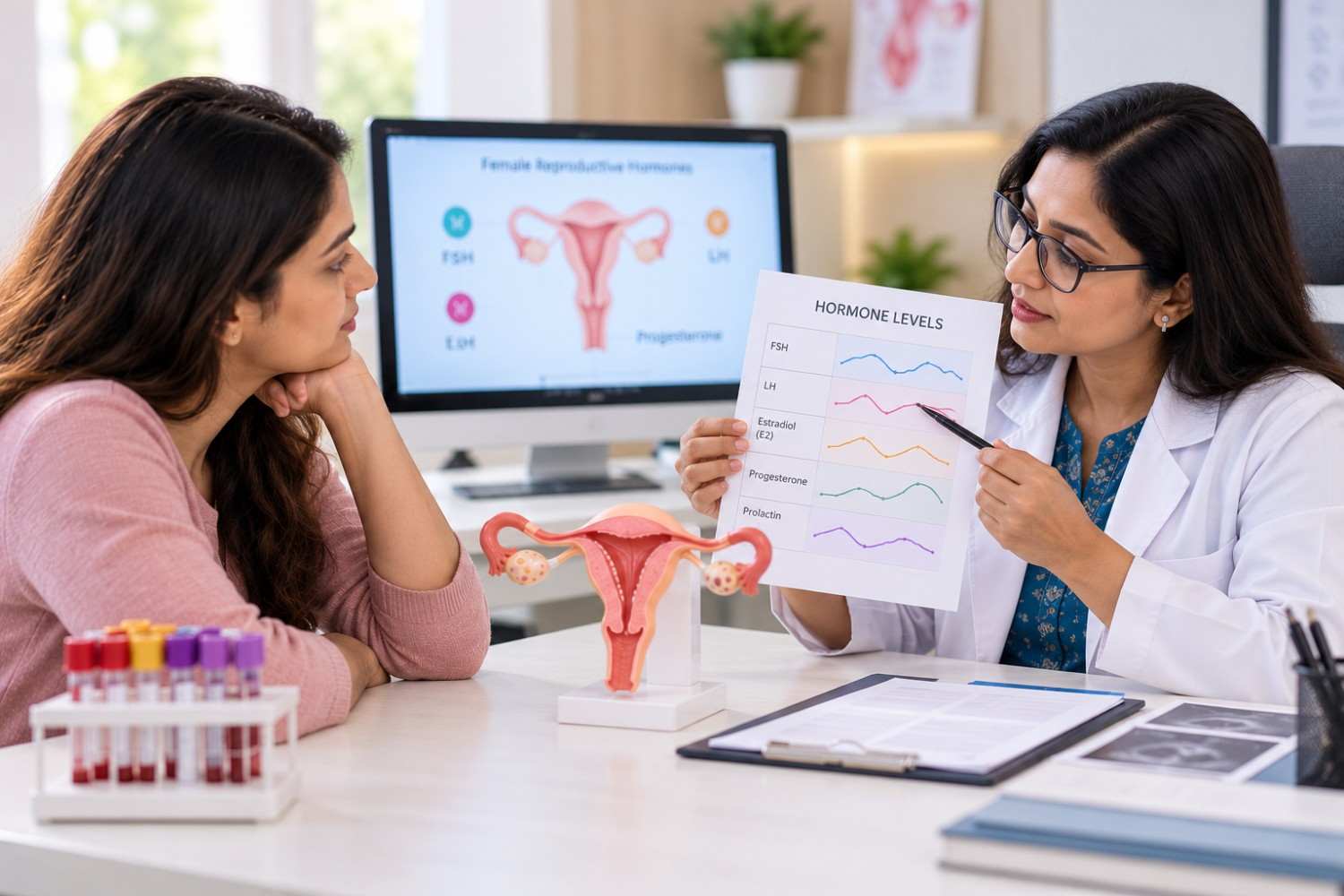
Hormones control almost every step of the menstrual cycle, from the growth of follicles in the ovary to ovulation and the preparation of the uterine lining. When periods are irregular, when conception does not happen, or when symptoms such as excess hair growth, acne or unexplained weight changes appear, a hormonal assessment can help to find out whether a hormone imbalance is involved.
This page explains which reproductive hormones are commonly tested, when and why they are tested, what the results may mean, and how abnormal findings are managed. It is general educational information. Test results must always be interpreted by a doctor in the context of your history, examination and scans.
A hormonal assessment is a set of blood tests, usually combined with a clinical history and a pelvic ultrasound, that evaluates the hormones involved in reproduction. It is not a single test, and the tests chosen depend on your symptoms, age and goals. The aim is to understand how the ovaries, the pituitary gland, the thyroid and other glands are working, and whether a treatable problem is present.
A targeted hormonal evaluation may be advised for:
Understanding the main hormone and metabolic tests used to evaluate ovarian function, ovulation, and endocrine health.
Follicle-stimulating hormone (FSH), luteinising hormone (LH) and estradiol are often measured on day 2 or 3 of the period. A raised FSH may suggest reduced ovarian reserve, while LH and estradiol give additional information about ovarian function. These values vary from cycle to cycle, so they are interpreted carefully along with other findings.
AMH is produced by the small follicles in the ovary and is commonly used, along with an ultrasound antral follicle count, to estimate ovarian reserve. It can be measured on any day of the cycle. AMH helps to predict how the ovaries may respond to stimulation, which is useful for planning IUI or IVF. It does not by itself measure egg quality, and a low value does not mean that pregnancy is impossible.
Prolactin is a hormone that stimulates milk production. Raised levels can interfere with ovulation and cause irregular or absent periods. Stress, certain medicines and thyroid problems can also raise prolactin, so the test may be repeated for confirmation, and it is best done in a calm, rested state.
Both an underactive and an overactive thyroid can disturb the menstrual cycle, ovulation and early pregnancy. Thyroid-stimulating hormone (TSH) is a common first test, with further thyroid tests when needed.
Progesterone is measured in the second half of the cycle, usually about a week before the expected period, to confirm that ovulation has occurred. The timing of the test depends on your cycle length and may be adjusted.
In women with symptoms of excess male-type hormones, tests such as total or free testosterone, DHEA-S and, in selected women, 17-hydroxyprogesterone may be advised to help identify PCOS or other less common conditions, and to exclude other causes.
Insulin resistance is common in PCOS and can affect ovulation and long-term health. Fasting glucose, a glucose tolerance test or other metabolic tests may be advised when relevant.
Depending on your situation, additional tests such as vitamin levels, cortisol or tests of other glands may be considered. A doctor orders only the tests that are likely to be useful, rather than a long routine panel.
Why test timing matters and how hormone levels are interpreted alongside your clinical history and ultrasound findings.
Timing matters for several hormones. Day 2 or 3 tests are done at the start of your period, mid-luteal progesterone is done in the second half of the cycle, and AMH, thyroid and prolactin tests can usually be done at any time, although some are best done in the morning. Fasting may be required for glucose-related tests. Please tell your doctor about any hormonal medicines, contraceptive pills, thyroid tablets or supplements, as these can change the results. If you have no periods at all, your doctor will advise when to test.
Normal ranges differ between laboratories and depend on age and the phase of the cycle, so results should be read against the reference range printed on your report. One abnormal value does not always mean a disease, and a normal value does not exclude every problem. Your doctor will interpret the results together with your symptoms, a pelvic ultrasound and, if necessary, other tests such as hysteroscopy or tubal assessment. Please avoid self-diagnosing from numbers on a report, which can cause unnecessary anxiety.
Combining blood test results with clinical evaluation helps diagnose underlying endocrine and reproductive conditions:
Hormone tests guide treatment but are not a treatment in themselves. Depending on the diagnosis, management may include:
Lifestyle Measures: Lifestyle measures such as healthy weight, balanced nutrition, regular activity and stress management, which are especially important in PCOS.
Endocrine Correction: Medicines to correct thyroid or prolactin problems.
Cycle Regulation & Ovulation: Medicines to regulate periods or to induce ovulation, with ultrasound monitoring.
Treatment Planning: Planning IUI or IVF based on ovarian reserve and other factors.
Realistic Counselling: Counselling on realistic fertility prospects and timing, particularly when ovarian reserve is reduced or the woman is over 35.
Hormonal tests are one part of a complete fertility evaluation. They should be considered together with a tubal assessment, uterine evaluation and the partner's semen analysis.
Dr. Sunita Arora is an obstetrician, gynaecologist and fertility specialist with more than 23 years of experience. She holds an MBBS from Lady Hardinge Medical College, New Delhi, and an MD in Obstetrics and Gynaecology from UCMS and GTB Hospital, and she is a Fellow of the Indian College of Obstetricians and Gynaecologists (FICOG) and a Fellow of the International College of Surgeons (FICS). She completed a fellowship in Reproductive Medicine at D.Y. Patil University, Mumbai, and received IVF training at RMA, Mount Sinai, New York.
Her special interests include infertility, IUI and IVF, and patients are guided through each step in clear, plain language, with test results explained in context.
If you have irregular periods, difficulty conceiving or symptoms that may be hormonal, a structured assessment can bring clarity.
She consults at Safdarjung Enclave and is also associated with Fortis La Femme, Greater Kailash II, serving women across South Delhi, including Greater Kailash, Green Park, Hauz Khas and nearby areas.
Dr Sunita Arora Fertility and Gynae Clinic
Fortis La Femme, South Delhi
Book an appointment with Dr. Sunita Arora, and bring any previous blood reports and scans.
Find answers to common questions about reproductive hormone testing, cycle timing, fasting requirements, AMH levels, and treatment options.
Medical disclaimer: This page is for general educational purposes and does not replace personalised medical advice, diagnosis or treatment. Please consult a qualified doctor about your own health. If you have severe abdominal pain, heavy bleeding, fainting or fever, seek urgent medical care.